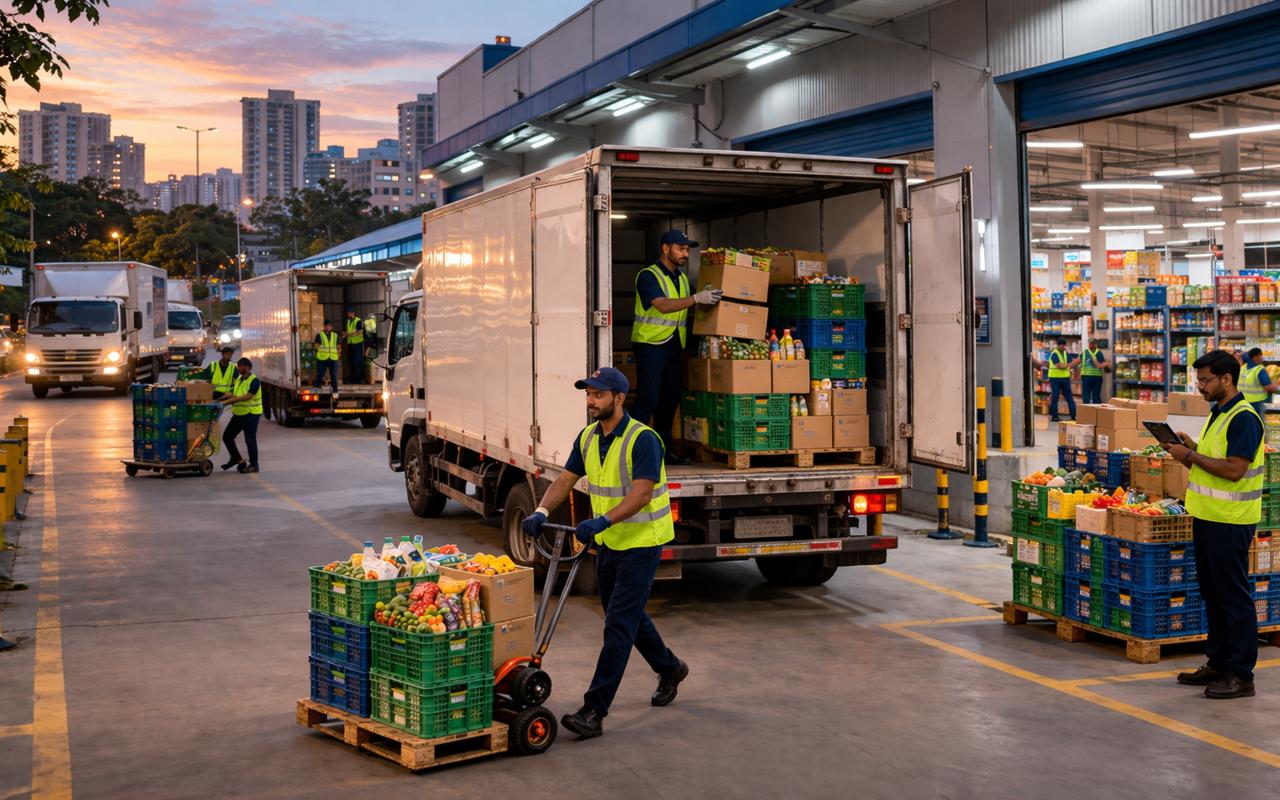
Quick commerce has changed how India shops. Customers expect groceries, medicines, and essentials in 10 to 30 minutes. Behind that promise sits a dense network of dark stores that must stay fully stocked at all times. This is where dark store replenishment logistics in India becomes critical, especially the mid-mile that connects warehouses to these stores.
In this blog, we break down how to design high-frequency PTL and FTL feeds that keep shelves full without slowing operations.
Why Quick Commerce Demands High-Frequency Replenishment
Traditional retail works on predictable cycles. Stores receive stock once or twice a week and hold inventory in the backroom. Quick commerce works differently.
A dark store is like a kitchen during peak dinner hours. Orders keep coming in, and ingredients must be available instantly. If tomatoes or milk run out, the store loses sales within minutes.
This leads to two major shifts:
- Higher delivery frequency: Instead of weekly deliveries, dark stores may need replenishment 2 to 6 times a day.
- Tighter cut-offs: A delay of even 30 minutes can cause stockouts and missed orders.
For example, a dark store in Bengaluru may see a spike in orders between 6 pm and 10 pm. If the mid-mile truck misses its 5 pm delivery window, the store will struggle through the evening rush.
Mid-Mile Design Choices That Matter
Designing the mid-mile is not about moving goods alone. It is about moving them at the right time, in the right quantity, and with zero friction.
1. Milk-Runs vs Point-to-Point
- Milk-runs: One truck serves multiple dark stores in a fixed loop.
- Best for dense urban clusters
- Reduces cost per delivery
- Works well when demand is stable
- Point-to-point: One truck goes directly from warehouse to a single store.
- Best for high-demand stores
- Faster and more predictable
- Ideal during peak hours
Think of milk-runs like a school bus that drops multiple students, while point-to-point is like a cab that goes straight to one destination.
2. Cross-Dock vs Hub Replenishment
- Cross-docking:
- Goods arrive and move out quickly without storage
- Reduces handling time
- Works well for fast-moving items like dairy and fresh produce
- Hub replenishment:
- Inventory sits at a regional hub before dispatch
- Helps buffer demand spikes
- Useful for non-perishables and slower SKUs
A balanced model often works best. For example, fresh items can flow through cross-docks, while packaged goods move via hubs.
3. Line-Haul Timing Windows
Timing is everything in quick commerce.
- Schedule line-hauls to match store demand peaks
- Avoid congestion at city entry points during rush hours
- Use staggered delivery slots for different store clusters
For instance, early morning line-hauls can stock up stores before breakfast demand, while afternoon runs prepare for evening peaks.
Load Building for Speed and Accuracy
Speed is not just about trucks moving fast. It starts with how you build the load.
Crate and Pallet Discipline
- Use standard crates for easy handling
- Pre-sort crates by store
- Label clearly to avoid confusion at unloading
This reduces unloading time from 30 minutes to under 10 minutes in many cases.
Grouping by Stock Keeping Unit (SKU) Families
- Pack similar items together such as beverages, snacks, or dairy
- Makes picking and restocking faster at the store
Imagine opening a delivery where all cold drinks are in one crate instead of spread across five. Store staff can refill shelves quickly and move to the next task.
Temperature Separation
- Keep frozen, chilled, and ambient goods separate
- Use insulated containers where needed
This is crucial for quality and compliance. A melted ice cream delivery is not just a loss, it affects customer trust.
KPIs That Buyers Actually Care About
Logistics success in quick commerce is measured in minutes, not days. Here are the key metrics that matter:
1. Replenishment OTIF (On-Time In-Full)
Did the shipment arrive on time and with the right quantity?
A high OTIF ensures that stores stay stocked without over-ordering.
2. Store Stockout Minutes
How long was a product unavailable on the shelf?
Even 15 minutes of stockout during peak time can mean dozens of lost orders.
3. Turnaround Time at Dark Stores
How quickly can a truck unload and leave?
Faster turnaround means more trips per day and better asset utilisation.
4. Damage Rate
What percentage of goods arrive damaged?
Lower damage means higher margins and fewer customer complaints.
Bringing It All Together
Designing dark store replenishment logistics in India is about precision. You are not just moving goods. You are supporting a promise of instant delivery.
A well-designed mid-mile network:
- Matches delivery frequency with demand patterns
- Chooses the right mix of milk-runs and direct routes
- Aligns line-haul timing with peak sales windows
- Builds loads that are easy to handle and quick to unload
- Tracks KPIs that reflect real store performance
For logistics providers, this is an opportunity to stand out. For brands, it is a way to ensure shelves stay full and customers stay loyal.
In quick commerce, the winner is not the one who delivers fast once. It is the one who delivers consistently, every hour, every day.