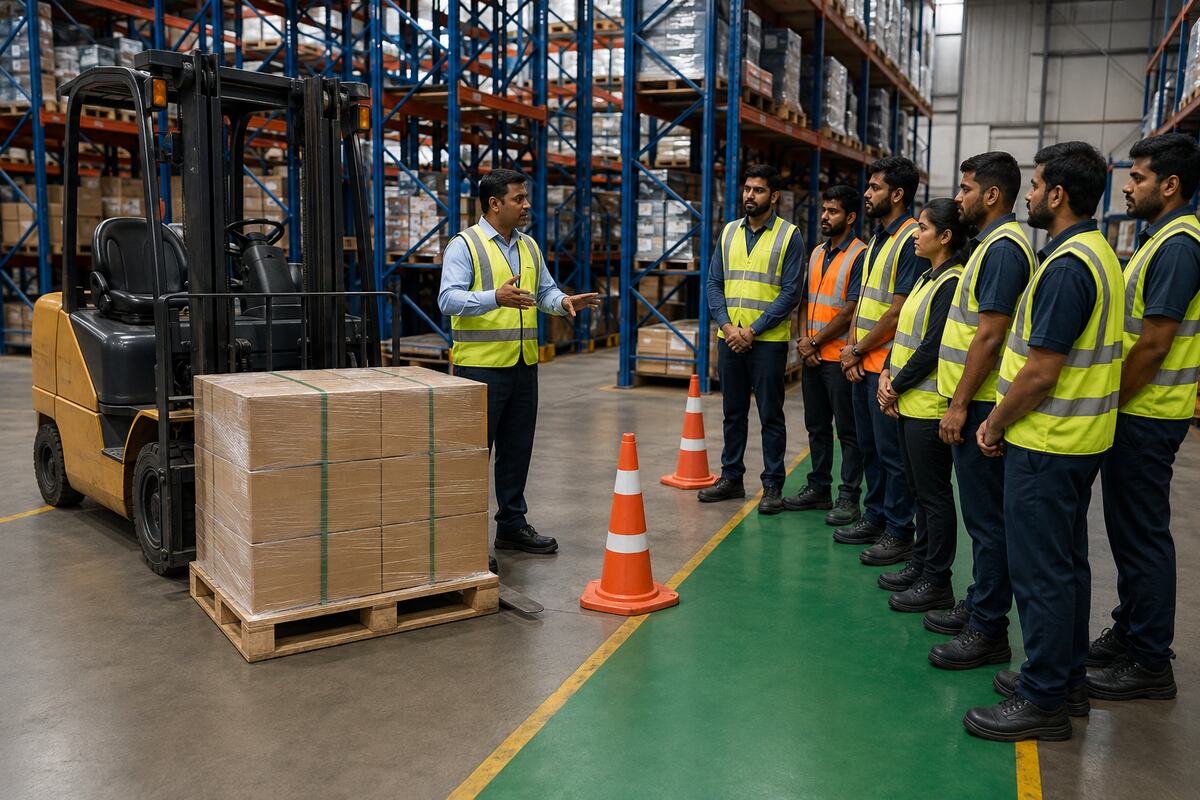
A forklift can move a heavy pallet in minutes, but one poor decision can put people, stock and equipment at risk. That is why effective forklift operator training in India must go beyond a classroom lecture or a one-time driving test. Warehouse teams need a clear skill path that combines knowledge, supervised practice, real workplace conditions and regular competency checks.
The goal is simple: operators should understand the equipment, demonstrate safe control and make sound decisions even when the warehouse becomes busy.
Start with knowledge, then practise under supervision
No operator should begin independent work immediately after a theory session. A practical training path should move through three stages.
First, trainees learn the basics. This includes equipment controls, warning indicators, steering behaviour, braking, load capacity, stability and the limits of different attachments.
Second, they practise in a controlled area. The trainer can use cones, empty pallets and marked lanes to teach starting, stopping, turning, reversing, stacking and parking without production pressure.
Third, the trainee works in the actual warehouse under close supervision. This step matters because every site has different aisle widths, blind corners, dock layouts, floor conditions and traffic patterns. A person who handles an electric counterbalance forklift well may still need separate instruction before using a reach truck or a different attachment.
The trainer should authorise independent operation only after the trainee completes a practical assessment on the equipment and tasks required for the role.
Make daily inspection part of forklift operator training
Safety begins before the forklift moves. Operators should learn a repeatable pre-use inspection routine that covers tyres, forks, mast, chains, hydraulics, brakes, steering, horn, lights, warning devices, battery or fuel system, seat restraint and visible damage.
The inspection should lead to action. If a brake feels weak or a fork appears damaged, the operator must know how to stop use, report the defect and prevent others from using the equipment until an authorised person clears it.
This habit works like a driver checking a commercial truck before a long trip. A two-minute observation can prevent a much larger problem later.
Teach load capacity as a practical concept
A capacity plate is not just a label to memorise. Operators need to understand how load weight, load centre, height and attachments affect stability. A long load can shift its centre of gravity even when its total weight appears acceptable. Damaged pallets, uneven stacking or loose wrapping can create further risk.
Training should include safe fork positioning, correct pallet entry, load checks and travel with the load lowered to a safe position. Operators should also practise stopping before raising or lowering a load and maintaining a clear view in the direction of travel.
Train pedestrians and operators together
Forklift safety does not belong only to forklift drivers. Pickers, supervisors, loaders, visitors and contract workers share the same space.
Joint sessions should explain pedestrian lanes, crossing points, right of way, exclusion zones, speed limits, blind corners and simple communication signals. Mirrors, barriers, floor markings and warning lights help, but people must understand how to use them.
For example, a pedestrian should never assume that an operator has seen them. The forklift may have a blocked view and a wide rear swing. A clear pause, eye contact and an agreed signal can prevent confusion.
Practise the difficult parts of the warehouse
A strong course uses the real risk points found on site. Operators should practise approaching dock edges, using dock plates, travelling on ramps, entering trailers, working near racking and responding to poor pallet condition.
The curriculum should also cover safe battery charging or refuelling, parking and shutdown. Trainers must show operators how a small shortcut, such as leaving forks raised or taking a turn too quickly, can affect someone several metres away.
Turn near misses into refresher training
Near-miss reports should become learning tools, not blame records. If several reports mention speeding near one blind corner, the business should review the route, visibility, floor markings and operator behaviour together.
Supervisors can use short observation checklists during normal work. A ten-minute coaching conversation based on an actual task often teaches more than repeating a general safety presentation.
Reassess skills when work changes
Competence can fade, and workplace conditions can change. Warehouses should reassess an operator after an unsafe event, a long break from driving, a role change, the introduction of new equipment or an attachment, or a major layout change. Periodic checks also help identify habits that have slowly moved away from the approved method.
PTC Logistics Skill Academy can help warehouse teams build practical capability through structured learning, supervised practice and workplace-focused assessment. When businesses treat training as an ongoing skill path, they protect people while supporting smoother material flow, better equipment care and more disciplined operations.