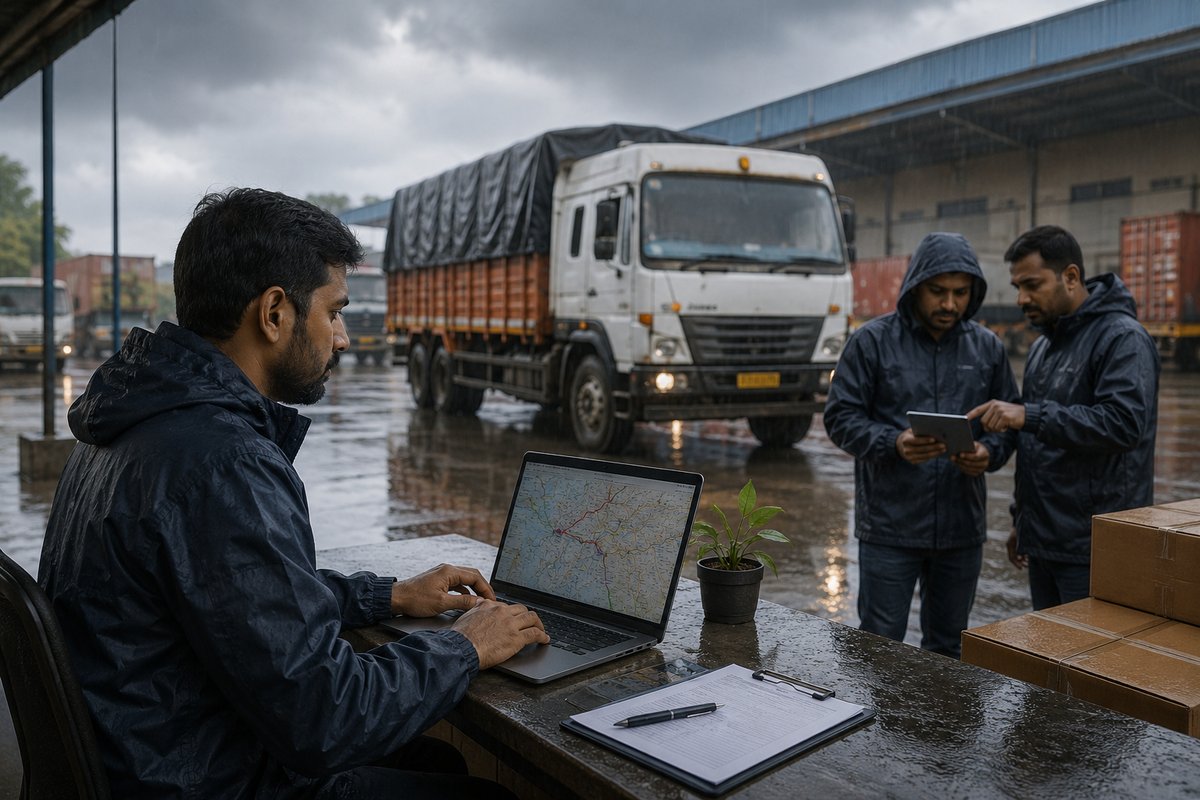
Every year, the monsoon tests India’s road freight networks. A route that runs smoothly in April can turn unpredictable by July. Waterlogged highways, traffic diversions, slower unloading, and sudden road closures can disrupt delivery plans within hours.
For logistics teams, monsoon disruption is not a surprise. The real challenge is preparation.
Strong monsoon logistics planning in India helps businesses reduce delivery delays, protect customer trust, and maintain operational control even when weather conditions worsen.
Here is a practical framework for preparing your road freight operations for monsoon season.
Why Monsoon Planning Matters in Road Freight
Think of monsoon logistics like planning a road trip during heavy rain. If you only know your main route and have no backup plan, one flooded road can ruin the journey.
Freight operations work the same way, just at a larger scale.
A delayed shipment does not only affect transport. It can disrupt production schedules, retail replenishment, customer commitments, and working capital.
That is why preparation needs to happen before the rain arrives.
Build a Lane-Wise Monsoon Risk Map
Not every freight route faces the same level of risk.
A Bengaluru to Chennai lane may face occasional traffic slowdowns, while a Mumbai to Surat corridor may experience severe waterlogging in certain stretches.
A lane-wise risk map helps operations teams understand where delays are most likely.
Your map should include:
Flood-Prone Road Sections
Identify highway stretches that historically experience flooding or severe traffic congestion during heavy rainfall.
For example:
- Low-lying industrial belts
- Urban choke points
- River crossing zones
- Roads under infrastructure repair
If a truck repeatedly gets delayed near the same point every monsoon, treat it as a predictable risk, not an unexpected event.
Alternate Route Options
Every critical lane should have pre-validated backup routes.
For instance, if the standard highway becomes blocked, can drivers safely switch to an alternate state highway?
Do not wait until the disruption happens to figure this out.
Check:
- Road suitability for heavy vehicles
- Toll implications
- Transit time differences
- Fuel cost impact
Night Driving Restrictions
Rain reduces visibility and increases accident risk.
Some routes may remain technically open but become unsafe for night movement during heavy rain.
Mark these restrictions in your route planning.
A truck that pauses safely overnight may still perform better than one stuck in an avoidable accident-related delay.
Create a Monsoon Contingency Playbook
A risk map shows where problems may happen.
A contingency playbook defines what to do when they happen.
Without a playbook, teams lose time debating decisions during live disruptions.
A good playbook should include:
Pre-Approved Reroutes
Operations managers should not need fresh approvals every time a route change becomes necessary.
Define approved alternatives in advance.
Example:
If NH48 flooding delays exceed 90 minutes, shift shipments to Route B automatically.
This speeds up response time.
Buffer Hubs
Temporary holding points can help protect delivery commitments.
Imagine a shipment moving toward a flood-affected city. Instead of leaving the truck stranded far away, move cargo to a nearby safe hub for reallocation.
Buffer hubs help:
- Split loads
- Reassign deliveries
- Reduce customer-facing delays
Think of them as backup airports during flight disruptions.
Standby Vehicles
When one truck becomes immobilized, replacement capacity matters.
Keep standby vehicle access ready in high-risk zones.
This is especially important for:
- Time-sensitive freight
- Retail replenishment
- Manufacturing supply runs
- Customer contract deliveries
Escalation Triggers by Severity
Not every issue needs senior management involvement.
Set clear escalation levels.
Example:
Level 1: Delay under 60 minutes
Operations team manages internally.
Level 2: Delay between 60–180 minutes
Customer service informed.
Level 3: Delay above 180 minutes or route closure
Management escalation and customer intervention plan activated.
Clear triggers reduce confusion.
Define Customer Communication SLAs (Service Level Agreements)
Customers do not expect perfect weather.
They do expect clear communication.
Silence damages trust faster than delay.
Strong communication SLAs should define how updates happen.
Update Cadence
Decide how often customers receive updates during disruptions.
For example:
- Initial disruption alert within 30 minutes
- Status updates every 2 hours
- Final recovery estimate once confirmed
Consistency matters.
Frequent vague updates are not helpful. Predictable meaningful updates are.
Evidence Standards
Customer updates should be factual.
Support messages with:
- GPS timestamps
- Driver confirmation
- Route closure notices
- Site photographs where relevant
Evidence prevents disputes.
Exception Messaging Templates
Teams lose valuable time writing ad hoc explanations during crises.
Prepare templates in advance.
Example:
Delay Alert Template:
“Shipment delayed due to severe rainfall-related traffic disruption near Pune. Revised ETA: 6:30 PM. Next update in 90 minutes.”
Route Change Template:
“To protect delivery timelines, shipment has been rerouted through an alternate corridor. Transit time impact estimated at 2 hours.”
Templates improve speed and consistency.
Track Operational KPIs That Matter
What gets measured gets improved.
Monsoon performance should have dedicated KPIs.
Delay Minutes by Cause
Break delays into categories:
- Flooding
- Traffic congestion
- Vehicle breakdown
- Driver halt
- Customer unloading delay
This shows the real problem areas.
Reroute Success Percentage
Measure how often alternate routes successfully reduce disruption.
Example:
If 20 reroutes happen and 15 recover planned delivery windows, reroute success is 75%.
Promise vs Actual Delivery Variance
Track the difference between promised and actual delivery times.
If promised delivery is 10 AM and arrival happens at 3 PM, the variance is 5 hours.
This KPI directly reflects customer experience.
Escalation Frequency
If one lane repeatedly triggers emergency escalation, planning needs improvement.
Patterns reveal weak points.
Final Thoughts
Monsoon logistics planning in India is not about avoiding disruption completely.
That is unrealistic.
It is about staying prepared, responding quickly, and communicating clearly.
Rain may be seasonal, but customer expectations remain constant.
The logistics teams that perform best during monsoon are not the ones hoping for better weather.
They are the ones planning for worse weather and operating with confidence.