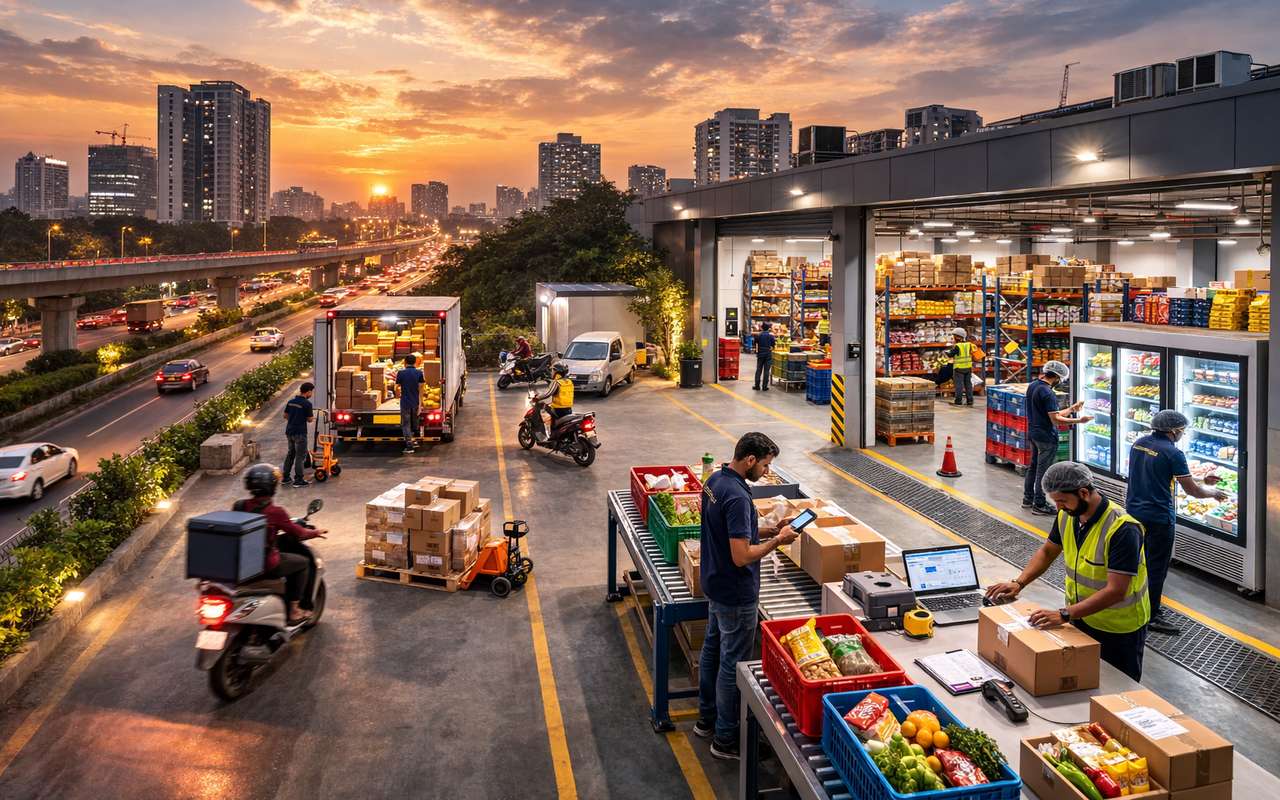
Urban India has changed how it shops. A customer in Bengaluru orders milk at 8 pm and expects it at the door in 10 to 15 minutes. That expectation has transformed how warehouses operate. Traditional distribution centers that once served retail stores now share space with dark stores and micro-fulfilment centers built for speed.
This shift defines the new era of quick commerce warehousing in India, where proximity and precision matter more than scale alone.
Why Quick Commerce Changed Warehouse Design
Quick commerce does not work from the edge of the city. It works from inside it.
Earlier, warehouses focused on bulk storage. Trucks unloaded pallets, and goods moved in large batches to stores. Now, dark stores sit inside residential clusters. They operate like small supermarkets closed to walk-in customers. Staff pick items for online orders only.
This proximity-first model reduces delivery time. A rider does not travel 15 kilometers. They travel two or three.
Ultra-fast picking drives the layout. Managers design aisles for speed, not display. High-demand items such as milk, bread, eggs, and snacks stay near the packing area. Think of it like organizing your kitchen. You keep daily-use items in the front cabinet, not on the top shelf.
High-frequency replenishment cycles support this model. Stock moves quickly. A dark store may restock multiple times a day from a larger hub. That constant flow requires tight coordination between transport, warehouse teams, and demand planners.
Dark Store Operating Model Essentials
1. Smart SKU Strategy
A hypermarket carries 20,000 or more products. A dark store might carry 2,000 to 3,000. The goal is not variety. The goal is relevance.
Operators select fast-moving Stock Keeping Unit (SKU) based on local demand. A store in Mumbai may stock more ready-to-cook meals. A store in Hyderabad may stock more rice varieties. Data guides these decisions.
2. Demand Forecasting
Quick commerce runs on accurate forecasts. If the team underestimates demand for milk on a rainy evening, they lose sales. If they overstock, they face wastage.
Teams use historical data, weather trends, and festival calendars to predict demand. For example, ice cream demand rises on hot weekends. Good forecasting reduces both stockouts and waste.
3. Intelligent Slotting
Slotting means placing products in the right location inside the store. High-frequency items stay near the dispatch counter. Slower items move to the back.
This simple design improves picker productivity. A picker who walks less picks more orders per hour. When each order must leave within minutes, every step counts.
4. Picker Productivity
Speed must not compromise accuracy. Teams track picks per hour and error rates. Clear labeling, barcode scanning, and handheld devices reduce mistakes.
Training plays a big role. A well-trained picker knows the layout like a taxi driver knows city roads.
5. Shrink Control
Shrink includes theft, damage, and expiry. In small urban stores, space is tight. Overstocking leads to spoilage, especially for fresh produce.
Operators monitor expiry dates daily. They rotate stock and maintain CCTV coverage. Shrink control protects margins in a business that already runs on thin spreads.
Compliance and Quality Guardrails
Quick commerce stores often handle food, over-the-counter items, and personal care products. Operators must maintain hygiene and storage standards.
Temperature-sensitive items such as dairy and certain medicines require cold storage. Teams monitor temperature logs and maintain backup power systems. Regular cleaning schedules reduce contamination risks.
Food safety guidelines and labeling rules apply just as they do in large warehouses. Small size does not mean relaxed compliance. In fact, urban stores face more scrutiny because they operate close to consumers.
Quality audits and standard operating procedures help maintain consistency across multiple locations.
Network Design: Connecting Micro-Fulfilment to the Larger Chain
A dark store does not work in isolation. It connects to a mother hub or a central warehouse that holds bulk inventory.
The mother hub receives goods from manufacturers. From there, operators send replenishment shipments to multiple dark stores through line-haul vehicles. For smaller volumes, they use part truckload consolidation. This approach reduces transport cost and improves truck utilization.
Think of the mother hub as a water tank and dark stores as taps. The tank must stay full. The pipes must remain clear. If the flow stops, the tap runs dry.
Strong network design ensures that replenishment arrives before shelves empty. Technology systems link inventory across hubs and stores in real time. When stock drops below a set level, the system triggers a restock request.
Market Context: Rising Demand for Grade A Warehousing
India continues to see strong demand for Grade A warehousing. Modern facilities offer high ceilings, better flooring, fire safety systems, and efficient loading bays.
Quick commerce companies and Third-party logistics (3PL) providers occupy a large share of this space. 3PLs help manage inventory, transport, and compliance for brands that want to scale quickly without building their own infrastructure.
Urban consumption growth, digital payments, and changing lifestyles support this expansion. As more consumers value convenience, companies invest more in fast fulfilment networks.
The Road Ahead
Quick commerce has redefined what a warehouse means in urban India. It is no longer a distant storage box. It is a living, fast-moving node inside the city.
Success in quick commerce warehousing in India depends on smart SKU choices, strong forecasting, efficient slotting, disciplined compliance, and seamless network integration.
Companies that treat dark stores as strategic assets rather than temporary solutions will build resilient urban logistics networks. In a market where minutes matter, the right warehouse design becomes a competitive advantage.